The Pickup Magnet Discussion Thread:

That is interesting about changing slugs to magnets. It would be very easy to do. I was able to move the slugs with my fingers on the coil I was playing with. Once removed from the baseplate it would take nothing to swap them. And no soldering required (if Adrian is paying attention).
 
I was doing some reading on the SD blog and they said that going from normal 3/4 inch pole screws to 1/2 inch can brighten a humbucker significantly. Mojotone sells both lengths if anyone wants to try it out. All of my current pups are pretty bright, but if I get one too dark I will give it a try.
 
And one of these days I'd like to try mitigating the "cocked-wah" sound of a DiMarzio humbucker by replacing the brass baseplate. Some feel this is a far bigger factor in the trademark DiMarzio vowel tone than has been widely recognized.

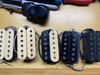
I forgot that DiMarzios used brass plates. Dug these out of the tool box, and sure enough... brass plates. All are seventies, or early eighties pedigree. The zebra coil pickup is a DiMarzio PAF(I’m pretty sure), and the other four are all Super Distortions. Second from the left has long legs, the others are all short.


F8093CFD-D49B-450C-A383-834AB61A64D4.jpeg
 
I forgot that DiMarzios used brass plates. Dug these out of the tool box, and sure enough... brass plates. All are seventies, or early eighties pedigree. The zebra coil pickup is a DiMarzio PAF(I’m pretty sure), and the other four are all Super Distortions. Second from the left has long legs, the others are all short.


View attachment 59543
There have been a few posts over on the Duncan forum about baseplate swaps.

That zebra isn't a PAF though - they had regular slugs & filister screws.
 
There have been a few posts over on the Duncan forum about baseplate swaps.

That zebra isn't a PAF though - they had regular slugs & filister screws.


I was looking those up after seeing your post. They must be all various versions of the Super Distortion..

Now that I know what they're worth, I'll probably sell them all. They're probably worth around $1200 for all five. Then there are the Shawbuckers in the same drawer. Could probably get a nice ES-345 for for the lot.
 
Then there are the Shawbuckers in the same drawer.
Shaw PAFs from Gibson, or the later Fender one that confusingly got named the Shawbucker?

I love the Gibson Shaws. Had to take 'em out of my stage guitars back in the day because they squealed at battle volume.
But everything else about them is fantastic: tone, dynamics, fingertouch, volume knob cleanup. All great.
One of my present ones was lightly potted by somebody - took care of the feedback, though it did ruin the date stamp.

Tim has said some of his Fender singlecoil designs are potted with shellac, rather than lacquer or wax.
Shellac doesn't penetrate the coils as deeply, and it doesn't deaden the highs like wax does - less even than lacquer, he says.
I've sometimes wondered if it might be worth trying shellac for potting humbuckers.
 
Shaw PAFs from Gibson, or the later Fender one that confusingly got named the Shawbucker?

I love the Gibson Shaws. Had to take 'em out of my stage guitars back in the day because they squealed at battle volume.
But everything else about them is fantastic: tone, dynamics, fingertouch, volume knob cleanup. All great.
One of my present ones was lightly potted by somebody - took care of the feedback, though it did ruin the date stamp.

Tim has said some of his Fender singlecoil designs are potted with shellac, rather than lacquer or wax.
Shellac doesn't penetrate the coils as deeply, and it doesn't deaden the highs like wax does - less even than lacquer, he says.
I've sometimes wondered if it might be worth trying shellac for potting humbuckers.


They came out of my '85 Les Paul. Someone had wired them with stacked pots so they could get single coil sounds out of them by splitting the coils. They are the worst things I have ever heard. I put some original spec PAF copies in the guitar years ago, wired them correctly, and have been happy ever since. It would be fun to hear how they sound wired properly to see if the hype is all that real. But, for what they are selling for these days, I may not refuse a good offer.
 
Last edited:
They came out of my '85 Les Paul. Someone had wired them with stacked pots so they could get single coil sounds out of them by splitting the coils. They are the worst things I have ever heard. I put some original spec PAF copies in the guitar years ago, wired them correctly, and have been happy ever since. It would be fun to hear how they sound wired properly to see if they the hype is all that real. But, for what they are selling for these days, I may not refuse a good offer.
Those are probably T-tops, I'm afraid.
Shaws didn't have 4-conductor leads; they can't be wired to split (unless somebody replaced the leads on yours).

T-tops have low output and a characteristic bright-but-not-harsh tone. That may account for why you didn't like 'em.
Personally I like T-tops in neck position. At the bridge, not so much: not meaty enough to suit me.
Still, tons of great music was made using 'em over the years.

If yours are uncovered you can check for the molded T on the top of the bobbins - Shaws didn't have that.
Also check the DCR: T-tops are pretty consistent at 7.4-7.5K.
Shaws are wound lighter, around 7k. I have one that's 6.97K and the highest I've seen was 7.2k.

Gibson only put Shaws in certain selected models, reissues mostly. Anything with the vintage 17 degree headstock angle, and long tenon one-piece mahogany neck would have them. This includes the KM and Heritage-80 Les Pauls, also Heritage series slab guitars like the korina Explorer and Moderne, plus a few special-edition "sorta reissues" like the first runs of the ES-335 Dot.

I had them as the stock pickups in a Standard-80, my '83 Guitar Trader burst reissue and the '82 Moderne.
But AFAIK no Shaws ever were used in regular production LPs and LPCs.

Then again, Gibson's been known sometimes to use what's at hand rather than what's specified.

A few of the distinguishing traits of Shaws were also shared by certain batches of T-tops.
Shaws were 2-wire with braided vintage style leads; most T-tops were too, though some had 4-way leads with a plastic sleeve.
Shaws used the Pat # baseplate; nearly all T-tops had that too.
Most Shaws had an ink stamp with a batch # or date. But some T-tops had that too, and some Shaws made near the end did not.

The surest identifier I know of for a Shaw is that the spacers are white plastic. AFAIK that's true for all of them.
But you can't see without removing the cover.
 
Those are probably T-tops, I'm afraid.
Shaws didn't have 4-conductor leads; they can't be wired to split (unless somebody replaced the leads on yours).

T-tops have low output and a characteristic bright-but-not-harsh tone. That may account for why you didn't like 'em.
Personally I like T-tops in neck position. At the bridge, not so much: not meaty enough to suit me.
Still, tons of great music was made using 'em over the years.

If yours are uncovered you can check for the molded T on the top of the bobbins - Shaws didn't have that.
Also check the DCR: T-tops are pretty consistent at 7.4-7.5K.
Shaws are wound lighter, around 7k. I have one that's 6.97K and the highest I've seen was 7.2k.

Gibson only put Shaws in certain selected models, reissues mostly. Anything with the vintage 17 degree headstock angle, and long tenon one-piece mahogany neck would have them. This includes the KM and Heritage-80 Les Pauls, also Heritage series slab guitars like the korina Explorer and Moderne, plus a few special-edition "sorta reissues" like the first runs of the ES-335 Dot.

I had them as the stock pickups in a Standard-80, my '83 Guitar Trader burst reissue and the '82 Moderne.
But AFAIK no Shaws ever were used in regular production LPs and LPCs.

Then again, Gibson's been known sometimes to use what's at hand rather than what's specified.

A few of the distinguishing traits of Shaws were also shared by certain batches of T-tops.
Shaws were 2-wire with braided vintage style leads; most T-tops were too, though some had 4-way leads with a plastic sleeve.
Shaws used the Pat # baseplate; nearly all T-tops had that too.
Most Shaws had an ink stamp with a batch # or date. But some T-tops had that too, and some Shaws made near the end did not.

The surest identifier I know of for a Shaw is that the spacers are white plastic. AFAIK that's true for all of them.
But you can't see without removing the cover.


Just checked, and there are white spacers. along with the ink stamps on the patent number base plates. Since mine is a bookmatched, flamed maple top, I suspect it was not originally standard production as they were still churning out three piece tops at that point. Someone probably paid too much to mess up the pickups by adding the stacked pots.
 
I've always been very partial to ceramic magnets.
I like them hot and with a lot of sizzle.

I have liked some pickups with a8 and a5 magnets as well.

I don't know the science behind it all specifically, but I know it when I hear it.
 
I remember a post years ago on the SDUGF from somebody who swapped a ceramic into a Duncan 59B.
He described it as a fire breathing monster.

Actually in the early 70s Seymour sometimes used to supercharge people's humbuckers by installing a ceramic mag.
He said these pickups had been "Seymourized."

A bit later there was a ceramic-powered standard Duncan model called the Seymourizer, the short-lived SH-7. This was found to be perfect for pairing at the neck with a Duncan Distortion bridge, so it was renamed the SH-6N Distortion Neck and is still being made today.

Uses a double thickness ceramic bar; these days not many realize that it makes a helluva bridge pickup.
 
My favourite pickups are the Japanese ceramic magnet single coils in my 1995 Fujigen made Fender ST54.

There's nowt so queer as folk, as we say here in Yorkshire. :p
The stock ceramic-mag singlecoils in MIM Strats sound really good too. Classic Strat tone with a little extra output, and without the extra mids and/or compression that overwound coils add. They can often be found very cheaply used since many swap them out in favor of "real" alnico pickups just on principle. And some of those folks find they don't like the replacements as much as the originals.
 
The stock ceramic-mag singlecoils in MIM Strats sound really good too. Classic Strat tone with a little extra output, and without the extra mids and/or compression that overwound coils add. They can often be found very cheaply used since many swap them out in favor of "real" alnico pickups just on principle. And some of those folks find they don't like the replacements as much as the originals.
I resemble that comment.
20210212_210842.jpg
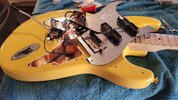
This MIM (in body only) has Fralin Blues Specials in it and I really don't care for the sound at all. Been thinking about getting another pickguard and going with Humbuckers, but I'm afraid to throw more money at something I may not play.
 
I have a set of Fralin Vintage Hots in one of my MIMs, and stock ceramics in the other.
I really like the Vintage Hots and have no regrets. They're richer without sacrificing any chime and I think they feel a little bouncier.
Lindy makes good stuff, no question.

Still, I can't say they completely transformed the guitar, like pickups sometimes have done for others.
 
Anyone ever see 3M #11 cloth acetate electrical tape locally in a store? Shipping is getting ridiculous on small orders these days, so if I can avoid ordering it from Mojo or the like I will.
 
I'm still really digging the Gibson BB61s with A2 magnets. I have some A2s, slugs and screws coming from that FX place on ebay. I think it was 1218 slugs and 1022 pole screws. I went with rough cast A2s. I'm going to see how close I can get to the BB61s. The info I found says they have 5261 turns on the screw side and 5000 on the slug side. I have some plain enamel 42 gauge that I will try it with. I still need to locate reasonably priced 49.2mm base plates. I got all the small parts from Philadelphia Luthiers. I will probably wait for Mojo to get the baseplates back in stock.
 
20210327_173008.jpg
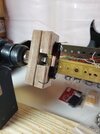
Winding has commenced. This is a 49.2 mm slug side bobbin loaded with plain enamel 42 awg. I broke the wire about 30 winds in, so I ripped it off and started over. I ran this for exactly 50 minutes at a 108 rpm average, so I should have around 5400 winds on this one. I will check resistance once I get the end wire attached.

I have to modify the winder before I fill the screw side bobbin. I didn't think about the holes being smaller on that one and my bolts are too large of a diameter. I have a piece of aluminum stock that I am going to fit with long humbucker height adjustment screws that will work for both bobbins.

I'm going to use 1018 long screws and 1022 slugs with wood spacers. A2 2.5 inch rough cast magnets will finish it off. I have a pair of A5 I can try if I don't like it.
 
I forgot that DiMarzios used brass plates. Dug these out of the tool box, and sure enough... brass plates. All are seventies, or early eighties pedigree. The zebra coil pickup is a DiMarzio PAF(I’m pretty sure), and the other four are all Super Distortions. Second from the left has long legs, the others are all short.


View attachment 59543

My DiMarzio has a nickel silver baseplate....and I specified short-leg mounting...

20210213_085959.jpg
 
Back
Top